

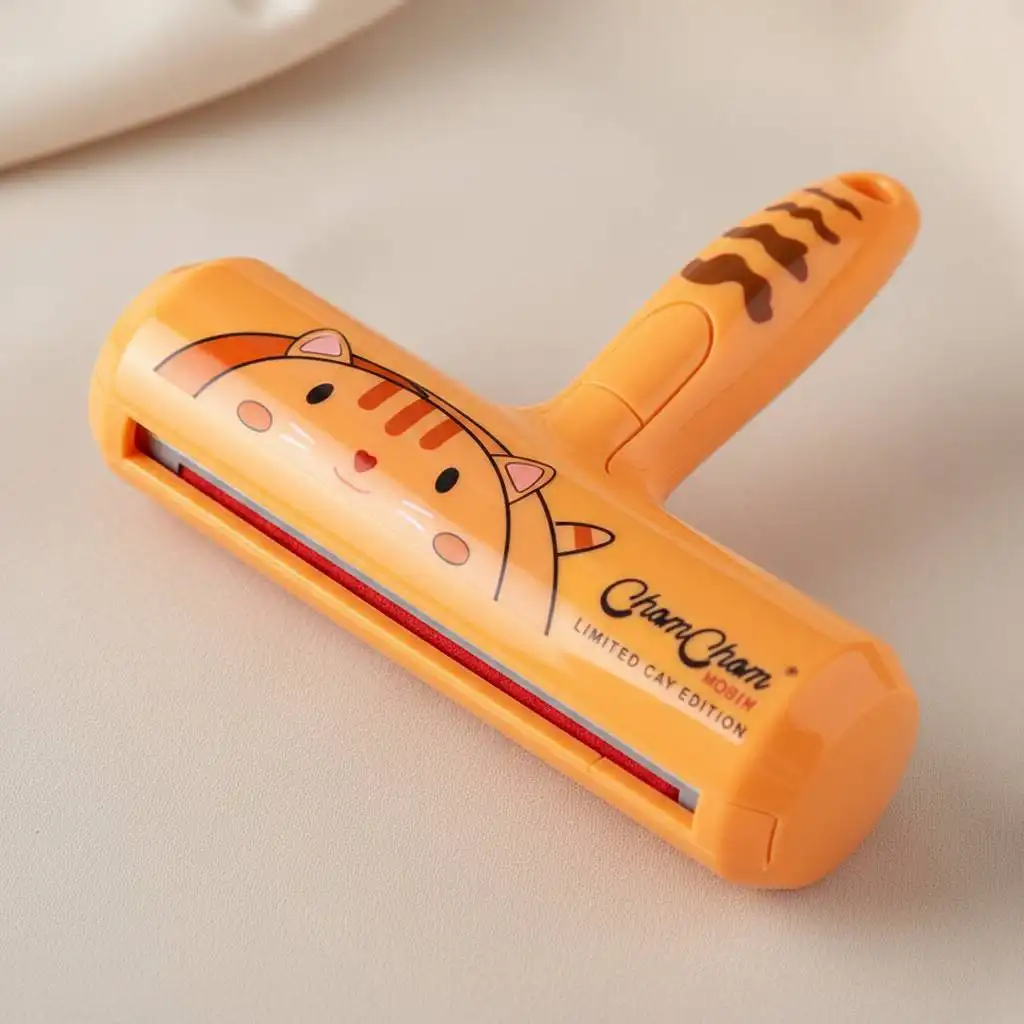
The ChomChom Lint Roller Review: Is It Finally Time to Break Up With Disposable Sticky Tape?
We need to talk about “The Peel.”
You know exactly what I’m talking about. You’re running late, your black jeans are covered in white fur, and you grab that plastic handle with the sticky roll. You swipe once, look down, and the sheet is already dead. Useless. So you peel it off, wad it up, and throw it in the trash. Then you do it again. And again.
By the time you leave the house, you’ve created a snowball of non-recyclable, adhesive-covered paper trash. And for what? To be hair-free for three hours until your Golden Retriever says hello?
I hit my breaking point last shedding season. I looked at my bathroom trash bin, overflowing with crumpled sticky sheets, and realized my cleaning habit was basically a landfill nightmare. I couldn’t keep doing it. That was the day I decided to test the chomchom roller pet hair remover and reusable lint roller.
I’m not here to sell you a gadget. I’m here to ask you to stop throwing your money—and our planet’s future—into the garbage bin.
The Dirty Secret of Traditional Lint Rollers
Let’s look at the uncomfortable math. If you are a pet owner, you aren’t just battling hair; you are battling waste. A standard sticky roller has about 60 sheets. If you have a shed-heavy dog or cat, you might burn through five to ten sheets in a single session just to debuff the sofa.
That means you are tossing a plastic core and mountains of chemically treated paper into the trash every week. It’s a single-use plastic habit that flies under the radar because it feels like “cleaning.” But it’s not clean. It’s wasteful.
Beyond the eco-guilt, there is the cost. Those refills add up. You are effectively paying a subscription fee to keep your clothes clean. This is where the chomchom lint roller enters the chat. It promises zero waste, zero refills, and zero guilt. But does it actually work, or is it just another “green” product that makes you work twice as hard for half the results?
How the ChomChom Actually Works (No Glue Required)
The first thing you notice is that it feels mechanical. It doesn’t rely on adhesive chemicals to grab the hair. Instead, it uses simple physics—specifically, static electricity and friction.
The roller head isn’t a continuous wheel. It’s a rocking mechanism. When you push and pull it, an internal wiper blade rubs against two strips of directional red velvet (nylon). This friction creates an electrostatic charge that snaps pet hair up off the surface and traps it inside the collection chamber.
It makes a very distinct sound. Clack-clack. Clack-clack. To some, it’s noisy. To me? That is the sound of saving money. That is the sound of not needing to buy a refill ever again.

The Big Question: Does the ChomChom Roller Work on Clothes?
This is the main reason you are here. Everyone knows this thing eats hair off sofas, but search engines are lighting up with people asking: does the chom chom roller work on clothes?
I’m going to be real with you. If you are trying to de-hair a silky blouse or a loose t-shirt while wearing it, the ChomChom is going to annoy you. It is aggressive. It is a heavy-duty tool, not a delicate wand.
Unlike a sticky roller that glides over anything, the ChomChom needs resistance to generate that static charge. If you roll it on a loose shirt, it just bunches the fabric up and pushes you around. It feels clunky.
The “Taut” Technique
However, you can use the chomchom roller for clothes if you change your technique. You cannot just swipe and go. You need to create tension.
- Method 1: Pull the fabric tight against your body with one hand while rolling with the other.
- Method 2 (The Best Way): Lay the garment flat on an ironing board or a bed. Hold the hem down firmly and go to town.
Best vs. Worst Fabrics for the ChomChom
It’s not a magic wand for everything. Here is where the chomchom roller clothes experience succeeds and fails:
- Where it Shines: Heavy denim jeans, thick wool coats, structured blazers, and fleece jackets. The fabric needs to be sturdy enough to stand up to the friction.
- Where it Struggles: Thin cotton t-shirts, silk, rayon, or flimsy synthetics. The roller will just drag the fabric back and forth without cleaning it.
Beyond the Wardrobe: Where This Tool Reigns Supreme
While we are scrutinizing its ability to clean your pants, we have to acknowledge where this thing is an absolute beast: your furniture.
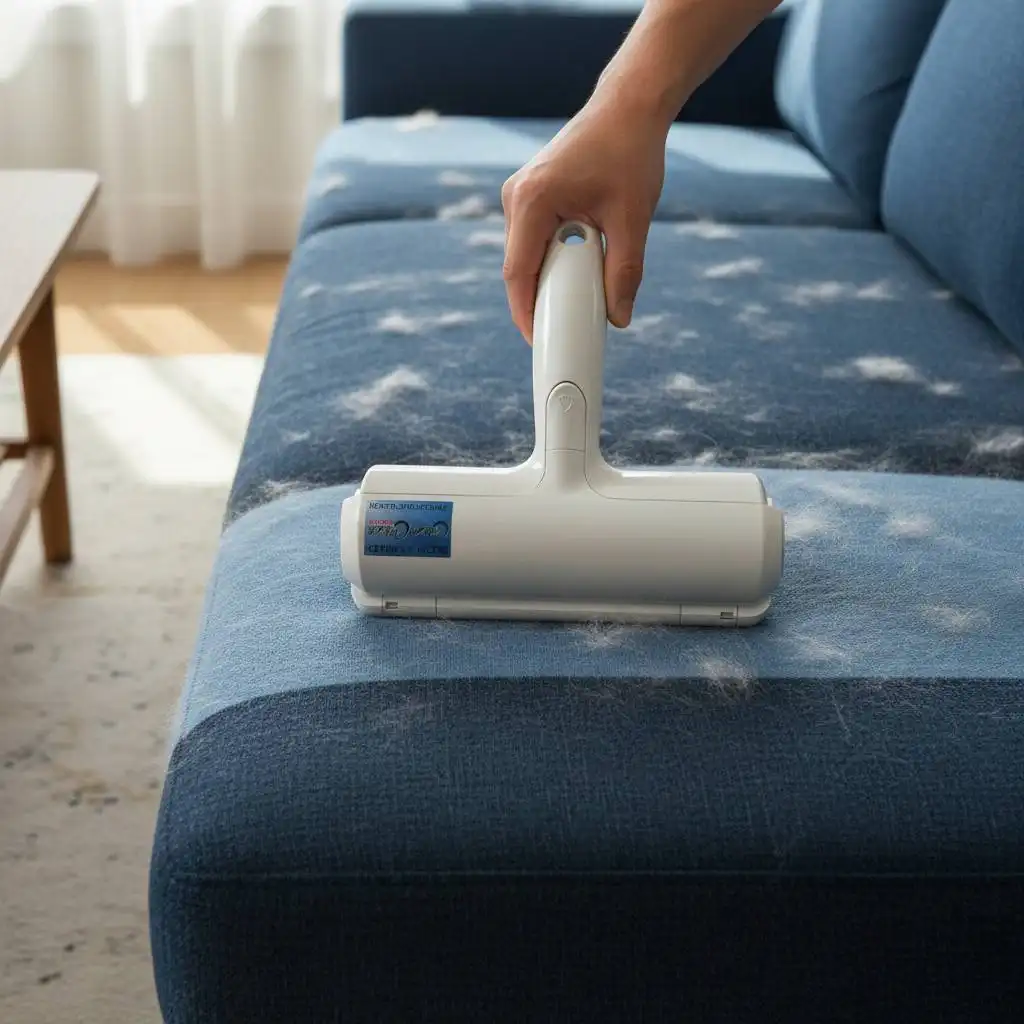
This is where the “green routine” gets satisfying. Sticky rollers barely touch the surface of a velvet couch. The ChomChom digs in. Because of that back-and-forth friction, it pulls up hair that has woven itself into the fabric fibers—hair that your vacuum cleaner probably missed.
I used this on a “clean” duvet cover and emptied a fist-sized ball of grey fur out of the trap. It was gross, but also deeply validating.
Maintenance and Longevity (The Zero-Waste Dream)
The best part of this tool is the disposal process. There is no peeling. You press a button on the back of the handle, the lid pops open, and you are greeted by a “hair brick”—a compressed roll of dust and fur.
You dump that directly into the bin. No extra plastic. No chemically treated paper sheets. Just the organic waste.
In terms of durability, this is a “buy once, cry once” situation. It’s built from rigid plastic. Unless you throw it at a wall, it’s going to last you for years. Contrast that with the hundreds of dollars you’d spend on sticky refills over the same period, and the math speaks for itself.
Is It Worth the Swap? Pros and Cons
Let’s break it down simply. Is it perfect? No. Is it better for the world? Yes.
| Feature | Traditional Sticky Roller | ChomChom Roller |
|---|---|---|
| Waste Generated | High (Sheets + Cores) | Zero (Reusable) |
| Lifetime Cost | Expensive (Constant Refills) | One-time Purchase |
| Effectiveness on Furniture | Low (Surface only) | High (Deep Clean) |
| Effectiveness on Clothes | High (Easy on all fabrics) | Medium (Requires technique) |
| Ease of Use | Effortless glide | Requires vigorous motion |
Final Thoughts: A Small Change with Big Impact
Look, I get it. Convenience is addictive. The sticky roller is easier to use on a flimsy t-shirt five minutes before a date. But we have to stop prioritizing 30 seconds of convenience over the health of our planet.
The ChomChom requires a slight learning curve for clothing. You have to learn to hold the fabric taut. You have to get used to the loud clacking sound. But once you make the swap, you stop being part of the single-use plastic problem.
It’s a solid tool, a money saver, and most importantly, it keeps the landfill empty. Make the switch.
FAQ: Common Questions About the Reusable Roller
How do you clean the ChomChom roller brushes?
You generally don’t need to wash the red velvet. The internal rubber blade scrapes the velvet clean every time you rock it back and forth. If it gets really dusty, wipe the velvet gently with a damp cloth. Do not soak it.
Can you use the ChomChom on human hair?
Yes, it picks up long human hair quite well, though it is designed for the finer texture of pet fur. Long human hairs can sometimes get wrapped around the squeegee blade, so you might need to pluck them out occasionally.
Is the ChomChom roller washable with water?
No! Do not submerge the ChomChom in water. The axle and internal metal springs can rust, and the velvet adhesive can degrade. Wipe the exterior with a damp cloth only.
Why is my ChomChom just pushing the hair around?
You are likely rolling it in one direction like a wheel. Stop that! You need to use short, vigorous back-and-forth strokes. The rocking motion is what pushes the hair into the trap.
