


The Science Behind the ChomChom: How It Eats Hair Without Creating Trash
We need to talk about the “Sticky Tape Graveyard.” You know exactly what I’m talking about. You stand there, peeling off that grey, fuzzy sheet of adhesive paper, you roll it across the sofa for exactly three seconds, and it’s full. So you peel it off, crumple it up, and throw it in the bin. Then you do it again. And again.
By the time you’ve cleaned one armchair, you’ve created a small mountain of non-recyclable waste. It’s a landfill nightmare. I reached my breaking point last year when I looked at my trash can after a “deep clean” of the living room. I realized I was literally wrapping the planet in non-biodegradable adhesive tape just because my cat decided the navy blue armrest was her bed.
That eco-guilt hit me hard. I’m Luna, and I’m not a professional cleaner, but I refused to believe that the only solution to pet hair was buying disposable rolls forever. That’s when I started looking into the mechanics of the ChomChom Roller. It’s not magic; it’s physics. And more importantly, it stops the cycle of waste.
The “Single-Use” Trap: Why We Need Better Tech
The traditional sticky roller is the ultimate example of planned obsolescence. It is designed to fail. The mechanism is simple: glue on paper grabs hair until the glue is covered. Once it’s covered, it is useless trash.
Peel. Roll. Trash. Repeat.
It’s an endless loop that drains your wallet and fills our oceans with microplastics. The adhesive sheets are coated with substances that make them nearly impossible to recycle. The ChomChom Roller represents a rebellion against this single-use culture. It doesn’t rely on a consumable resource to work; it relies on mechanical engineering.
No Batteries, No Glue: The Static Science
So, how does the ChomChom roller work if it’s not sticky? The answer lies in simple electrostatic attraction and friction. It’s the same science you learned in high school.
Remember rubbing a balloon on your head and watching your hair stand up? That is essentially what is happening here. The roller isn’t made of tape; it uses two strips of a specific red directional velvet fabric (technically a micro-bristle lint brush material).
When you rub this material against your furniture, the friction creates a localized electrostatic charge. This charge pulls the hair off the fabric of your sofa and onto the red velvet strips. But here is the kicker: You are the power source. The kinetic energy of your hand moving the device creates the charge. No lithium-ion batteries to mine, no cords to plug in.

The Secret is in the “Chom” (The Motion)
This is where most people get it wrong. If you use the ChomChom like a sticky roller—rolling it in one long, smooth motion—it won’t work. It will just drag the hair around.
To engage the mechanism, you have to perform a rapid back-and-forth motion. You push and pull in short, vigorous strokes.
Click-clack. Click-clack.
That sound? That is the sound of the internal mechanism flipping. It’s the “chom-chom” noise that gives the tool its name. Honestly, if you are looking for a silent cleaning tool, this isn’t it. The ChomChom is loud, clunky, and sounds like you’re breaking it when you use it correctly—but that clunkiness is exactly why it works better than flimsy sticky tape.
The Rubber Blade Mechanism: How It “Swallows” the Hair
The genius of the design is what happens inside the head during that back-and-forth motion. The tool features two opposing strips of that red velvet. In the center, separating them, is a thin grey rubber squeegee or blade.
When you push the roller forward, the front velvet strip picks up the hair. When you pull it backward, the internal mechanism flips. The rubber blade scrapes across the velvet strip you just used, peeling the hair off the velvet and shoving it deep into the rear containment chamber.
It acts like a windshield wiper for fur. It constantly cleans its own brushes as you use it, so you never lose suction power (or in this case, friction power).
The Catch Chamber: Where the Fur Goes
This is the most satisfying part for anyone trying to live a zero-waste lifestyle. On the back of the roller head, there is a small trap door.
When you pop that lid open, you don’t see a sticky mess. You see a perfectly compressed “log” of pet hair, dust, and lint. Because the rubber blade packs the hair in tightly, it stays contained until you empty it.
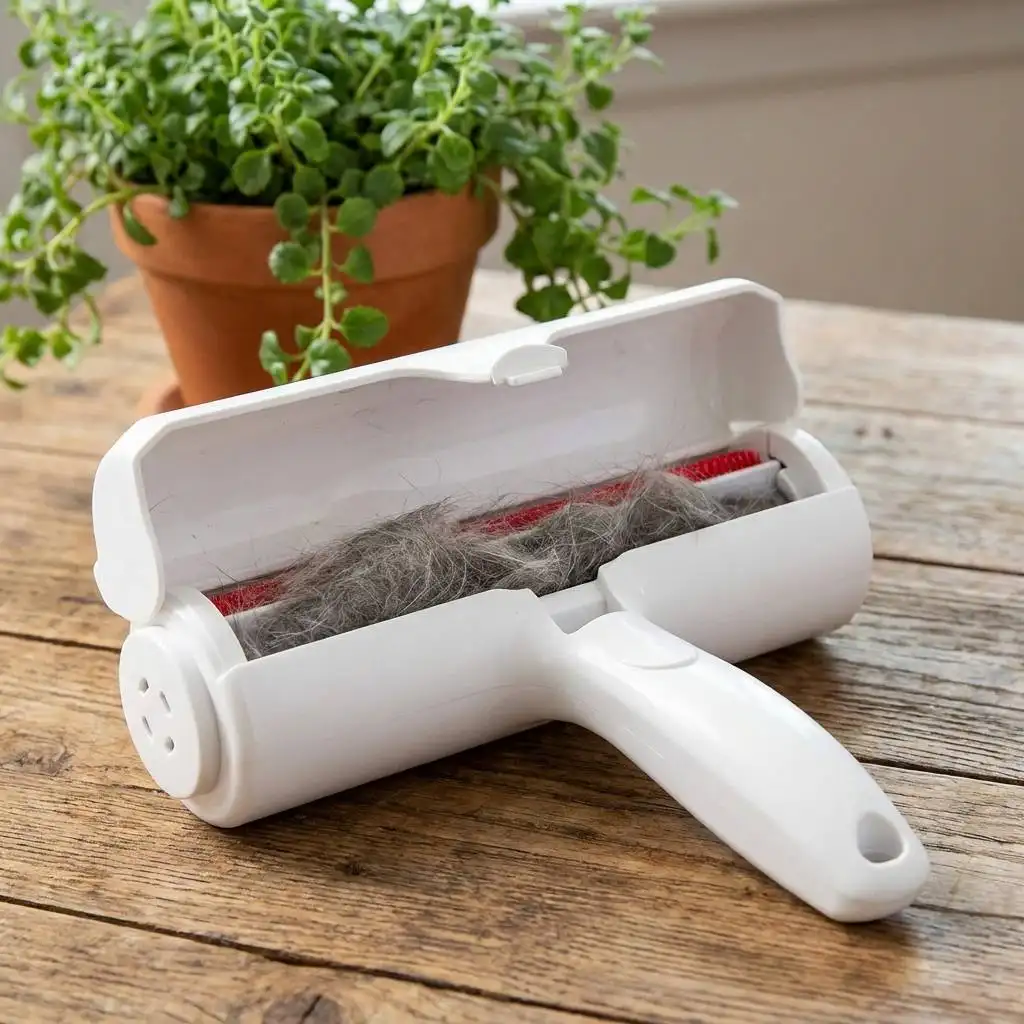
You dump that hair ball into the compost (yes, pet hair is compostable!) or the trash. You keep the tool. Nothing goes to the landfill except the organic matter. No plastic sheets, no cardboard cores. Just the fur.
ChomChom vs. Sticky Tape (The Eco-Impact)
Let’s look at the hard data. It’s easy to ignore the cost of $5 here and there, but the environmental cost is massive. Here is how the “Fur-pocalypse” stacks up against a sustainable solution:
| Feature | Sticky Roller | ChomChom Roller |
|---|---|---|
| Lifespan | A few days/weeks | Years (Indefinite) |
| Waste Created | Hundreds of coated paper sheets + plastic handles | Zero plastic waste after purchase |
| Cost | Recurring ($5/month forever) | One-time investment |
| Recyclability | Near Zero (mixed materials) | 100% Reusable |
When you buy a ChomChom, you are effectively opting out of the disposable economy. It is an investment in the planet.
Where the Tech Fails (Honest Limitations)
I’m an activist, but I’m also a realist. I hate “green-washing” where we pretend eco-products are perfect. The ChomChom has limitations based on its physics.
Because it relies on friction, it needs a surface that provides resistance. It works beautifully on taut sofas, bed sheets, and car interiors. However, it struggles on loose, unanchored rugs because the rug just bunches up when you do the aggressive back-and-forth motion.
Furthermore, the mechanism is too rough for delicate silks or loose knits—the stiff bristles can snag. And don’t try it on wet surfaces; moisture kills the static charge instantly.
Maintenance: Keeping the Mechanism Alive
Just because it doesn’t need refills doesn’t mean you can neglect it. To keep it out of the trash and in your cleaning arsenal, you need to treat it right.
- Clean the Red Fabric: If the velvet gets grimy, wipe it with a damp cloth. Do not soak it.
- Protect the Blade: Never pick at the rubber blade with sharp objects (like scissors) to get hair out. Let the mechanism do the work.
- No Baths: Submerging the roller will rust the internal metal spring pins. Keep it dry.
FAQ: De-Mystifying the Roller
Does the ChomChom roller lose its stickiness?
No, because it was never sticky to begin with! It relies on the texture of the micro-bristles. As long as the fabric isn’t worn down (which takes years), it will keep working.
Can you wash the ChomChom roller?
No! Water ruins the internal mechanism and can warp the plastic housing. A damp cloth is all you need.
Why does my ChomChom just push the hair around?
You likely aren’t doing the back-and-forth motion correctly. If you just roll it forward, the rubber blade never engages to scrape the hair into the trap. You need that aggressive “chom-chom” motion to clear the bristles.
